The Ultimate SUPER SACK® FIBC Guide
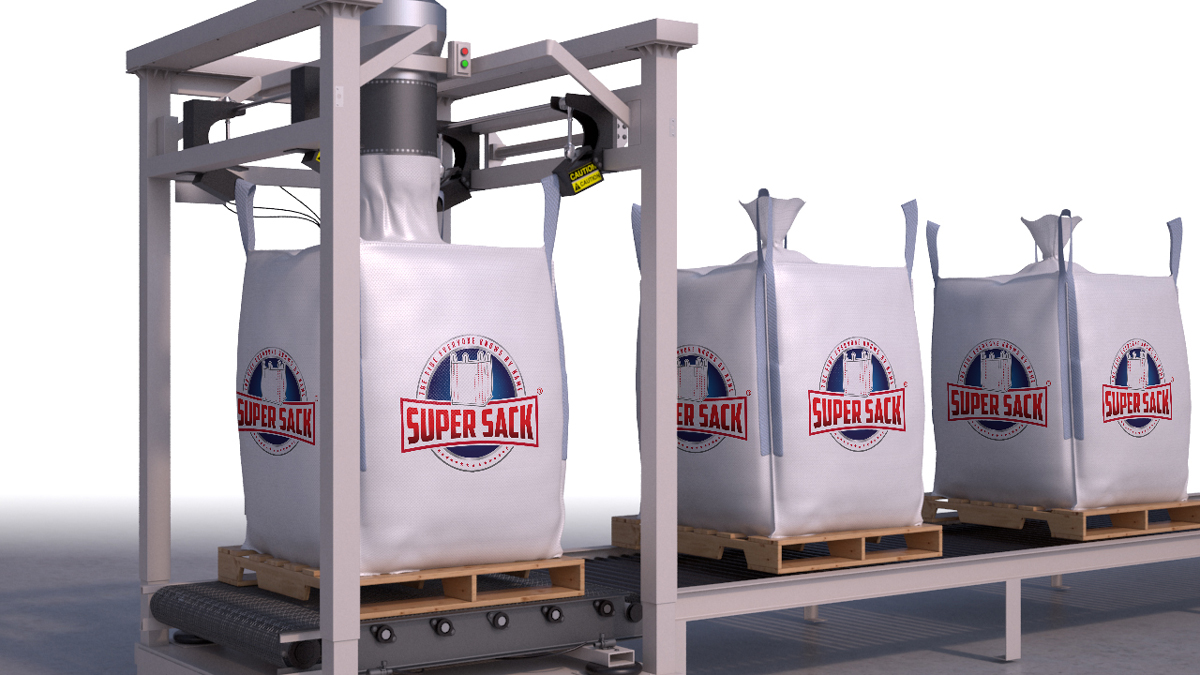
Selecting the right SUPER SACK® FIBC isn’t just about bag size — it’s about safety, efficiency, and total cost of ownership. The wrong configuration can lead to product loss, unstable stacking, or freight inefficiencies. From base dimensions to fabric construction, every decision affects how your product is filled, stored, and shipped. The right SUPER SACK® FIBC balances three key factors: safe working load (SWL), bulk density, and bag dimensions.
Understanding these fundamentals helps you protect your workforce, ensure compliance, and improve operational efficiency. This guide will walk you through the terminology, sizing standards, design variations, and FAQs so you can confidently select the best SUPER SACK® FIBC for your products and operations.
Understanding the Terminology
- Safe Working Load (SWL): The certified maximum filled weight the SUPER SACK® FIBC is rated to carry (in lbs or kg). This is your target filled weight per bag.
- Safety Factor (SF): Industry design standard. This is typically 5:1 for single-use (one-way) bags and 6:1 for multi-use/UN. A 5:1 bag must withstand 5x its SWL before failure in testing; a 6:1 bag withstands 6x its SWL.
- Bag Base Dimensions (Width x Length): The bag footprint, often designed to match a common pallet (e.g., 35” x 43” or 40” x 48”).
- Bag Height: Determines usable volume and varies based on product density and desired capacity.
- Bulk Density (lbs/ft³): The weight per cubic foot of your product — the key factor in calculating the right bag volume for your target SWL.
SUPER SACK® FIBC Standard Sizes & Weight Capacity
Standard FIBC bases are aligned to common pallet and container footprints. Height is then adjusted based on product density and target SWL. Use the matrix below as a directional starting point, then validate against your product and handling environment.
Industry Standard Base Sizes
- 35” x 35” Square: The most common in North America; fits standard 40” x 48” pallets.
- 36” x 36” Square: Slightly larger footprint for improved stacking and stability.
- 41” x 41” Square: Designed for efficient use in containers (20’ or 40’) — ideal for export operations.
Volume Calculation
Formula (directional planning): Required Volume (ft³) = Target SWL (lbs) ÷ Product Bulk Density (lbs/ft³) Example: If your product has a bulk density of 40 lbs/ft³ and you need a 3,000 lb SuperSack FIBC: 3,000 ÷ 40 = 75 ft³ of bag volume required. Final volume and height should be validated against real-world factors like fill method, settling/compaction, liners, and desired headspace.
How SUPER SACK® FIBC Bulk Bag Design Affects Dimensions
- Baffle Bags: Internal baffles maintain a square shape when filled, improving stackability and allowing up to 25% more cubic efficiency than non-baffled bags.”
- Circular FIBCs: Made from a continuous tube of woven fabric; more cost-effective but may “bulge” slightly, increasing the filled footprint.
- Varying Loops: Four-loop, cross-corner, stevedore, and tunnel loops are chosen based on equipment and workflow — they don’t change bag capacity.
- Top Designs: Spout, duffle, and open top styles affect filling method and overhead clearance, but not certified SWL.
SUPER SACK® FIBC Sizing Q&A
Use these quick FAQs as a final rationale check on sizing before you finalize your specs for safe transport.
How much space should I leave in the bag (headspace)?
Allow sufficient headspace for product settling and safe closure — typically 4–8 inches above the fill line, depending on product type and fill method.
What is the maximum SWL United Bags, Inc. offers?
United Bags offers FIBCs with SWLs ranging from 500 lbs to over 5,000 lbs, depending on fabric, liner, and safety factor requirements.
Does the Safety Factor (SF) affect dimensions?
No — SF impacts construction strength and testing, not physical dimensions.
What is the most common SUPER SACK® FIBC bag dimension?
The industry standard is typically a bag with a 35″×35″ base and a height between 42″ and 60″.
Efficient SUPER SACK® FIBC Solutions Start with United Bags, Inc.
There’s no one-size-fits-all approach to FIBCs. The right SUPER SACK® FIBC is designed around your product’s density, handling conditions, and shipping requirements. A properly selected SUPER SACK® FIBC enhances safety with the right safe working load and safety factor, lowers freight costs, and improves overall performance with smart design features such as baffles, liners, and lifting loops. With decades of experience serving agriculture, chemical, food, and industrial sectors, United Bags can help you determine the right construction, dimensions, and SWL rating to maximize safety and efficiency.